Share with your loved ones
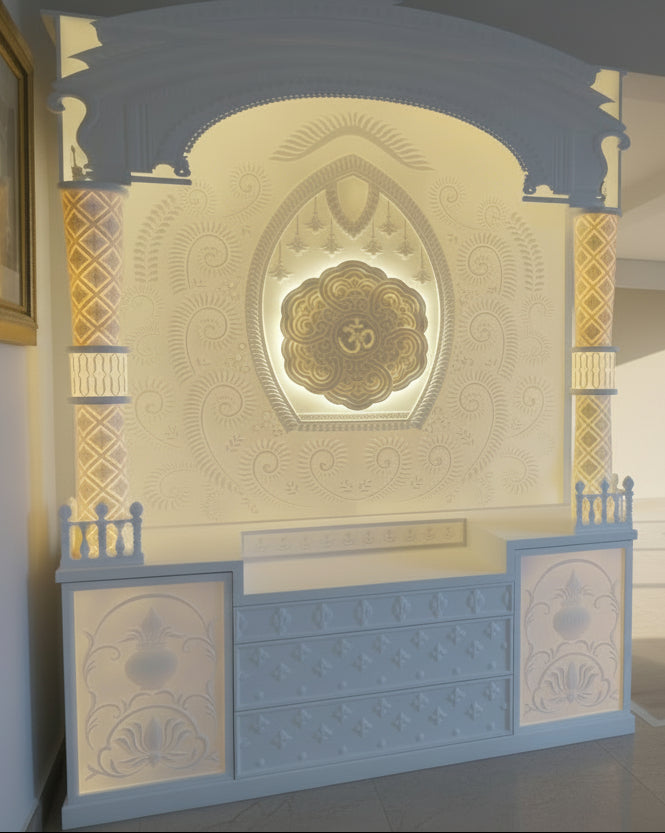
Premium 3D Backlit Corian Temple Mumbai with Tapered Round Pillars
Fully customisable at no extra cost
Temple Size ( Inchs)
Height-72.0"
Width-24.0"
depth-15.0"
Material
Material
Imported-Made in Korea (Branded)
Couldn't load pickup availability

Hand made
Exclusive design
Made in Bharat
100% Satisfaction
Premium Quality
Buy on EMI/Gpay
Custom made for you
Top rated seller on google
Premium 3D Backlit Corian Temple Mumbai with Tapered Round Pillars Hexagon Om Motif | Unique Traditional Arc Design Open Side Mandir | Multi-Layer Relief Carved Cabinet Latest Design India - Satguru Creations
Latest Premium Corian Mandir Design with 3D Backlit Tapered Round Pillars | Hexagonal Om Mandala Backlit Profile Arc Traditional Architecture | Multi-Layer Relief Carved Cabinet Open Side Temple | Contemporary Sacred Geometry Meets Classical Design Mumbai India
This latest premium Corian temple design from Satguru Creations Mumbai represents a groundbreaking fusion of contemporary architectural elements with timeless traditional temple design principles. The temple's most distinctive feature - magnificently tapered round pillars with 3D backlighting - creates an unprecedented visual statement that sets this design apart from conventional rectangular pillar temples while maintaining complete cultural authenticity.
The hexagonal Om mandala centerpiece combines sacred geometry perfection with sophisticated profile LED backlighting, creating a multi-dimensional spiritual focal point unlike any traditional flat Om design. The six-sided geometric framework references ancient Shatkona (six-pointed star) symbolism representing the union of masculine and feminine divine energies, while the profile backlighting technique creates a luminous halo effect around the sacred Om symbol.
The temple's unique traditional arc architecture features multi-layer 3D relief carving that extends comprehensively across the entire structure - from the elaborately carved arch crown with radiating sunburst patterns, to the intricately detailed cabinet section with floral and geometric motifs, to the distinctive open side design that showcases the substantial tapered pillars as prominent sculptural elements rather than concealing them behind walls.
Built from premium imported solid surface material wrapped on marine plywood BWP/BWR foundation, featuring professional LED backlighting in multiple zones, and incorporating expert CNC carving with hand-finished perfection, this temple represents the absolute pinnacle of contemporary Corian temple design while honoring classical Indian temple architectural traditions.
With 50+ years of three-generation manufacturing excellence and 10,000+ temples delivered worldwide, Satguru Creations introduces this latest innovative design proving that sacred architecture can evolve aesthetically while maintaining spiritual authenticity.
Distinctive Tapered Round Pillars - Architectural Innovation
Three-Dimensional Cylindrical Columns with Progressive Tapering
Revolutionary Pillar Design Philosophy:
Traditional temple pillars are typically uniform width from base to capital - either square or round with consistent diameter throughout. This latest premium temple design introduces architectural tapering - pillars that gradually narrow from base to top creating:
Visual Elegance:
- Graceful proportions reminiscent of classical Greek and Roman columns
- Refined sophisticated appearance suggesting upward movement toward divine
- Optical lightness - tapered form appears less heavy than straight columns
- Contemporary architectural language while maintaining traditional function
Structural Logic:
- Wider base provides stability and visual grounding
- Narrower top reduces weight on upper structure
- Natural proportion following principles found in nature (tree trunks taper upward)
- Engineering efficiency maximizing strength where needed, minimizing material where possible
Tapered Pillar Specifications:
Base Diameter (Bottom):
- Measurement: 7-7.5 inches diameter at floor level
- Substantial presence: Wide base creates commanding architectural statement
- Visual weight: Anchors temple composition providing solid foundation
- Carving surface: Larger diameter allows more elaborate decorative patterns
Capital Diameter (Top):
- Measurement: 5-6 inches diameter at arch connection
- Progressive reduction: 25-35% narrower than base creating elegant taper
- Delicate refinement: Slender top creates graceful transition to arch
- Proportional harmony: Sized perfectly for arch support without appearing heavy
Taper Angle:
- Gradual progression: Approximately 1-2 inch diameter reduction per 3 feet height
- Subtle transition: Taper noticeable but not extreme - maintains cylindrical integrity
- Classical ratio: Following architectural golden proportions for aesthetic perfection
- Computer-calculated: CNC programming ensures mathematically precise taper both sides
Height & Proportion:
- Total pillar height: Typically 5-6 feet from base to arch (depending on temple size)
- Height-to-base ratio: Approximately 7:1 to 9:1 creating slender elegant appearance
- Classical reference: Similar proportions to Doric, Ionic, Corinthian columns adapted for Indian temple
- Vastu compliant: Proportions calculated following sacred architectural principles
Comprehensive 3D Surface Carving - Complete Cylindrical Decoration
360-Degree Relief Patterns on Tapered Round Surface
Advanced Cylindrical Carving Technology:
Carving intricate 3D patterns on tapered cylindrical surface presents exponentially greater technical challenge than flat panels:
Manufacturing Complexity:
- 3/4-axis CNC requirement: Standard 3-axis machines cannot follow curved tapered surfaces
- Rotary indexing: Pillar must rotate on fourth axis while cutting tool carves
- Taper compensation: CNC programming adjusts for changing diameter throughout height
- Continuous surface: Pattern must flow seamlessly around circumference without flat spots
- Depth consistency: Carving depth must remain uniform despite diameter changes
Our Technical Capability:
- Multi-axis CNC routers: Equipped with rotary tables for complete round surface machining
- Advanced CAM software: Sophisticated programming calculating tool paths for tapered cylinders
- Real-time adjustment: CNC system compensates for taper angle maintaining pattern integrity
- Precision verification: Digital measurement confirming uniform depth and spacing around circumference
Pillar Surface Decoration Zones:
Upper Capital Section (12-16 inches):
Inverted Lotus Capital:
- Overhanging petal crown: Traditional temple column capital with carved lotus petals
- Petal count: 16-24 individual petals each separately carved with vein details
- Relief depth: 8-12mm deep carving creating substantial three-dimensional overhang
- Undercut technique: Advanced carving creating actual overhang not possible on flat surface
- All-around detail: Petals visible from every viewing angle circling complete circumference
Decorative Bead Molding:
- Circular bead bands: Multiple rows of spherical beads carved in perfect rings
- Mathematical precision: Beads equally spaced around changing diameter maintaining symmetry
- Dimensional relief: Each bead projects 4-6mm creating tactile texture
- Classical reference: Traditional architectural molding adapted for cylindrical tapered surface
Upper Decorative Zone (14-18 inches):
Diamond Lattice Pattern:
- Geometric precision: Interlocking diamond shapes creating continuous pattern
- Diagonal orientation: Diamonds angled approximately 45° creating dynamic visual movement
- Consistent sizing: Despite taper, diamond proportions maintain uniformity
- 3-5mm relief depth: Sufficient dimension for shadow creation and visual interest
- Seamless continuity: Pattern flows without interruption around entire circumference
Floral Garland Band:
- Lotus and parijat flowers: Stylized blossoms linked in continuous garland
- Vine connection: Decorative vines connecting flowers creating organic flow
- Varied flower positions: Some blooms, some buds, some leaves creating natural variety
- 4-8mm relief variation: Foreground flowers deeper, background elements shallower
- 360° composition: Beautiful from every viewing angle
Central Ornamental Zone (16-24 inches):
Primary Decorative Motifs:
- Sacred symbols: Om, Swastik, lotus prominently carved on principal viewing sides
- Peacock feather eyes: Stylized peacock feathers with distinctive eye patterns
- Geometric medallions: Circular decorative panels with intricate internal patterns
- Rangoli-inspired designs: Traditional floor art patterns adapted for vertical cylindrical surface
- 6-10mm deep relief: Primary motifs carved substantially for clear visibility
Background Pattern Fill:
- Fine texture: Entire background carved with subtle texture preventing plain appearance
- Small-scale patterns: Tiny geometric or organic patterns filling spaces between main motifs
- 2-3mm shallow relief: Background depth sufficient for interest without competing with foreground
- Visual cohesion: Background patterns tie together disparate decorative elements
Lower Foundation Zone (12-18 inches):
Architectural Base Molding:
- Multiple horizontal bands: Stacked carved rings creating traditional column base
- Varying profiles: Some concave, some convex, some flat creating dimensional complexity
- Bold shadow lines: Deep grooves between bands creating strong horizontal emphasis
- Lotus petal foundation: Row of upward-facing lotus petals at absolute base
- Transitional design: Carved elements gradually simplifying toward floor merger
Torus Molding:
- Convex semi-circular band: Traditional torus molding common in classical architecture
- Smooth flowing curve: Expertly carved convex surface polished to perfection
- Visual weight: Creates substantial appearance grounding slender tapered pillar
- All-around continuity: Molding circles complete circumference
Professional LED Backlighting - Tapered Pillar Illumination
Sophisticated Lighting Design for Cylindrical Tapered Columns
Unique Lighting Challenges:
Backlighting tapered round pillars requires specialized approach:
Technical Considerations:
- Changing diameter: Light must cover variable width from base to top
- Cylindrical surface: Even light distribution around 360° circumference
- Carved relief: Lighting must accentuate three-dimensional patterns effectively
- No flat mounting surface: LEDs cannot mount on flat panel - must adapt to curve
- Aesthetic concealment: Light source must be invisible from all viewing angles
Our Professional Solution:
Vertical LED Strip Installation:
- Multiple vertical strips: 3-4 LED strips positioned around pillar circumference (120° or 90° apart)
- Behind-pillar mounting: LEDs adhered to wall surface behind pillars
- Strategic positioning: Strips placed to backlight carved patterns optimally
- Warm white 2700-3000K: Color temperature creating golden glow on pillar surface
Graduated Light Distribution:
- Base zone brightest: More LED density at wider base creating strong foundation glow
- Progressive reduction: LED density decreases toward narrower top matching taper
- Balanced illumination: Despite diameter change, light intensity appears uniform
- No hotspots: Careful positioning prevents bright spots or dark areas
Grazing Light Technique:
- Angled positioning: LEDs aimed to create grazing light across carved relief
- Shadow accentuation: Side-lighting creates dramatic shadows emphasizing 3D depth
- Texture revelation: Grazing light makes subtle carved details prominently visible
- Artistic effect: Transforms pillars into sculptural artwork at night
Lighting Control:
- Independent pillar zone: Both pillars controlled together as dedicated lighting zone
- Dimmer capability: 0-100% brightness adjustment
- Synchronized or independent: Can match other zones or create unique pillar emphasis
- Scene integration: Programmed into preset lighting scenes (morning, evening, meditation, festival)
Visual Effects Achieved:
Glowing Cylindrical Columns:
- Backlit tapered pillars appear as luminous architectural elements
- Light creates halo effect around pillar circumference
- Carved patterns illuminated from behind creating depth and dimension
- Pillars transform from decorative to dramatic sculptural art
Room Ambient Contribution:
- Glowing pillars provide significant ambient room lighting
- Light reflects off adjacent walls creating warm inviting atmosphere
- Reduced need for harsh overhead lights during worship
- Evening presence - temple maintains beautiful illuminated presence throughout evening
Day-Night Transformation:
- Daytime: Pillars appear as elegantly carved tapered columns
- Evening/Night: LED illumination transforms into glowing luminous sculptures
- Dynamic appearance: Temple looks different throughout day maintaining visual interest
Hexagonal Om Mandala - Sacred Geometry Centerpiece
Six-Sided Geometric Framework with Profile Backlit Om Symbol
Sacred Geometry Significance:
The hexagon (Shatkona) is profound symbol in Hindu sacred geometry:
Spiritual Symbolism:
- Six-pointed star (Shatkona): Represents union of Shiva (upward triangle) and Shakti (downward triangle)
- Perfect balance: Masculine and feminine divine energies in perfect harmony
- Creation symbol: Six directions (North, South, East, West, Up, Down) representing complete cosmos
- Stability: Hexagon is nature's most stable and efficient geometric form (honeycomb structure)
- Sri Yantra connection: Hexagons appear within complex Sri Yantra sacred geometry
- Chakra association: Anahata (heart chakra) represented by six-pointed star
Mathematical Perfection:
- Internal angles: Each 120° creating perfect geometric harmony
- Symmetry: Six-fold rotational symmetry representing divine order
- Tessellation: Hexagons tile perfectly representing infinite cosmic pattern
- Golden ratio relationships: Hexagon proportions relate to phi (1.618) sacred proportion
Hexagonal Framework Design:
Six-Sided Border Structure:
- Precision geometry: Perfect hexagon with mathematically equal sides and angles
- Size: Hexagon typically 18-24 inches point-to-point (depending on temple size)
- Border width: 2-3 inch wide hexagonal frame creating defined edge
- Raised relief: Frame carved 4-6mm raised from background creating dimensional border
- Golden outline: Hexagonal border outlined in contrasting golden tone emphasizing geometry
Corner Point Treatment:
- Decorative elements at six points: Small lotus, Om, or geometric flourishes at each hexagon vertex
- Radiating lines: Subtle carved lines extending from points suggesting energy radiation
- Symbolic placement: Points aligned with cardinal and intercardinal directions
- Visual anchors: Corner decorations emphasize hexagonal geometry
Central Om Symbol - Multi-Layer Construction:
Om Carved Relief (Foreground):
- Large central Om (ॐ): 8-12 inch height sacred syllable perfectly centered
- Deep carving: 10-15mm relief depth creating substantial three-dimensional presence
- Beveled edges: Smooth angled edges creating elegant curves
- Golden finish: Om rendered in rich golden tone contrasting white/ivory background
- Hand-polished: Final finishing by skilled artisan ensuring perfect smoothness
Mandala Pattern Background (Middle Layer):
- Circular mandala: Concentric rings of lotus petals radiating around Om
- Multiple petal rings: 3-5 rings progressively larger outward
- Petal count variation: Inner ring 8 petals, middle 16, outer 24-32 creating traditional progression
- 5-8mm relief depth: Medium depth creating visual layer between Om and hexagon frame
- Subtle carving: Detailed enough for interest, not competing with central Om
Hexagon Interior Fill (Background Layer):
- Geometric patterns: Subtle triangular or diamond patterns filling hexagon interior
- 2-3mm shallow relief: Background texture preventing plain flat appearance
- Radiating design: Patterns emanating from central Om suggesting divine energy projection
- Tonal variation: Slight color variation or texture creating depth
Profile Backlighting System - Revolutionary Technique:
What is Profile Backlighting:
Unlike traditional flat backlighting where light shines directly through from behind, profile backlighting uses:
Edge-Lit Technology:
- LED strips positioned around hexagon perimeter: LEDs mounted at hexagon frame edges (not directly behind)
- Light enters frame edge: Illumination enters semi-translucent hexagonal frame from sides
- Internal diffusion: Light travels through frame material creating edge-glow effect
- Profile illumination: Hexagon frame itself glows - not the interior Om
Visual Effect:
- Glowing hexagonal outline: Six-sided geometric frame appears as luminous light border
- Dark interior contrast: Om and mandala remain non-backlit creating dramatic contrast
- Halo effect: Glowing hexagon creates divine halo surrounding sacred Om
- Floating appearance: Central Om appears to float within luminous geometric portal
- Dimensional depth: Multi-layer construction accentuated by selective lighting
Technical Implementation:
Frame Material:
- Translucent Corian: Special light-diffusing solid surface for hexagon frame
- Opacity calibration: Material translucent enough for light transmission, opaque enough to diffuse evenly
- Edge preparation: Frame edges precisely finished for optimal light entry
- Thickness: 15-20mm thick frame allowing adequate light travel distance
LED Installation:
- Six LED segments: One LED strip along each hexagon side (total 6 strips)
- Edge-mounted: LEDs positioned perpendicular to frame edge shining into material
- Even distribution: LED density calculated for uniform glow entire frame length
- Color matching: All six segments precisely color-matched for consistent appearance
- Independent control: Hexagon profile lighting controllable separately from other zones
Power and Control:
- Low-voltage system: Safe 12V/24V DC operation
- Dedicated transformer: Separate driver for profile lighting ensuring optimal performance
- Dimming capability: 0-100% brightness adjustment
- Warm white or golden: Color temperature selected to enhance golden Om and create divine glow
Layered Lighting Composition:
When all temple lighting activates, the hexagonal Om becomes focal point through contrast illumination:
- Glowing hexagon frame: Profile-backlit perimeter shining brightly
- Dark Om and mandala: Central elements non-backlit appearing in golden tone
- Radiant surrounding: Carved sunburst and radiating patterns around hexagon backlit from main background
- Dramatic focus: Eye immediately drawn to dark Om within luminous hexagonal portal
- Spiritual symbolism: Light (divine knowledge) surrounding Om (ultimate reality) - profound visual theology
Unique Traditional Arc Architecture - Multi-Layer Relief Masterpiece
Elaborate Carved Arch with Radiating Sunburst and Decorative Patterns
Arc Design Philosophy:
This temple's traditional arc is not simple curved top - it's comprehensive architectural composition featuring:
Classical Arch Form:
- Pointed arch apex: Central peak creating upward spiritual emphasis
- Symmetrical curves: Perfectly balanced left and right sides
- Proportional span: Arch width calculated using golden ratio relative to temple width
- Height proportion: Arch rise appropriate to create graceful curve without extreme point
Multi-Layer 3D Carving:
Foreground Layer - Bold Relief Elements (8-15mm depth):
Central Sunburst Radiation:
- Radiating rays: 20-30 carved rays emanating from arch apex like divine light
- Progressive sizing: Rays longest at center, gradually shorter toward sides creating natural taper
- Three-dimensional relief: Each ray carved as raised element projecting substantially from surface
- Alternating patterns: Some rays smooth, some textured, some beaded creating visual variety
- Symbolic meaning: Sunburst represents divine illumination, spiritual enlightenment, cosmic energy
Side Decorative Panels:
- Large lotus medallions: Carved lotus flowers in full bloom positioned at arch sides
- Om symbols: Sacred syllable carved at key architectural points
- Kalash pots: Sacred pot symbols representing abundance and purity
- Geometric patterns: Large-scale diamonds, stars, circles creating bold statements
Middle Layer - Intermediate Detail (4-8mm depth):
Ornamental Border Bands:
- Bead-and-reel molding: Classical architectural molding circling arch perimeter
- Lotus petal borders: Continuous band of carved petals framing arch
- Wave scroll patterns: Flowing S-curves creating organic decorative bands
- Geometric ribbons: Interlocking patterns weaving around arch edge
Connecting Vine Work:
- Decorative vines: Organic flowing vines connecting major decorative elements
- Leaf clusters: Groups of stylized leaves adding natural organic feel
- Flower buds and blooms: Small flowers interspersed throughout vine work
- Continuous flow: Vine patterns guide eye smoothly around arch composition
Background Layer - Subtle Foundation (2-4mm depth):
Textured Fill Patterns:
- Fine geometric texture: Tiny repeating patterns preventing plain empty background
- Organic surface treatment: Subtle carved texture resembling natural stone or fabric
- Gradual variation: Texture density varying slightly creating subtle visual interest
- Unified field: Background texture tying together all foreground elements
Three-Dimensional Shadow Play:
The multi-layer construction creates constantly changing appearance as lighting changes:
Morning Light (Side Angle):
- Dramatic long shadows from foreground elements
- Middle layer details clearly visible with medium shadows
- Background texture subtle but present
- Overall high-contrast appearance emphasizing depth
Midday Light (Overhead):
- Shorter shadows, less dramatic contrast
- All three layers clearly distinguishable
- Intricate details throughout visible
- Balanced even appearance
Evening Light (Artificial):
- Strategic spotlighting creates theatrical shadows
- Foreground elements dramatically highlighted
- Background falls into subtle shadow creating mystery
- LED backlighting from hexagon adds additional dimension
Arch Integration with Hexagon:
Radiating Connection: The sunburst rays emanating from arch apex visually connect with hexagonal Om below:
- Rays appear to radiate from divine source descending toward hexagonal portal
- Creates visual narrative: Divine light from above focusing through sacred geometry to manifest as Om
- Architectural composition tells spiritual story without words
- Upper (arch) and central (hexagon) elements unified through radiation motif
Comprehensive Cabinet 3D Carving - Complete Decorative Treatment
Multi-Layer Relief Extending Throughout Base Section
Cabinet Section Design Philosophy:
Many premium temples feature plain or minimally decorated cabinets - storage considered purely functional. This latest design extends the same multi-layer 3D carving excellence throughout base section:
Left Cabinet Door Panel:
Central Medallion Design:
- Large circular medallion: 12-16 inch diameter decorative panel centered on door
- Lotus mandala interior: Concentric lotus petal rings within circle
- 8-12mm relief depth: Substantial carving creating sculptural presence
- Golden accent option: Medallion can be golden-toned contrasting with door
Surrounding Decorative Field:
- Floral corner elements: Lotus or parijat flowers in four corners
- Vine borders: Organic vines framing medallion creating rectangular frame
- Geometric fill patterns: Background filled with subtle geometric texture
- Multi-depth composition: Foreground medallion, middle-ground vines, background texture
Right Cabinet Door Panel:
- Mirror symmetry: Identical or complementary design to left door
- Balanced composition: Visual weight equal creating harmonious pair
- Unified aesthetic: Both doors together create single composition when closed
Drawer Front Panels (If Included):
Continuous Design Flow:
- Geometric border bands: Simplified patterns appropriate to drawer scale
- Lotus motif elements: Small stylized lotus designs
- Coordinated relief depth: 2-4mm carving matching overall aesthetic without overwhelming
- Visual continuity: Drawer patterns flow naturally from cabinet door designs
Side Panel Decoration:
Left Side Panel (Visible):
- Vertical decorative band: Narrow ornamental strip running full height
- Simplified patterns: Appropriate for side viewing angle
- Lotus and vine motifs: Organic patterns creating vertical emphasis
- 2-3mm relief depth: Subtle but preventing plain appearance
Right Side Panel:
- Mirror decoration: Matching left side panel maintaining symmetry
Cabinet Base Molding:
Lower Foundation Edge:
- Traditional molding profile: Classical base molding finishing cabinet bottom
- Multiple layers: Stacked molding creating dimensional edge
- Shadow lines: Deep grooves between molding layers creating visual definition
- Smooth transition: Molding merging cabinet cleanly with floor/platform
Open Side Design - Distinctive Architectural Choice
Pillar Prominence Through Deliberate Spatial Openness
What is "Open Side Design":
Traditional Enclosed Temple:
- Solid side panels connecting front worship area to back wall
- Pillars concealed within or against solid walls
- Enclosed box-like appearance
- Visual weight and mass
This Open Side Design:
- No solid side panels - sides remain open revealing wall behind
- Pillars stand independently as prominent sculptural elements
- Visual lightness - temple appears less box-like, more architectural
- Spatial integration - temple doesn't completely separate from room, feels integrated
Why Open Sides Enhance Design:
Pillar Showcase: The substantial tapered pillars are too beautiful to conceal:
- Architectural sculpture: Pillars function as freestanding art pieces
- 360° visibility: Open sides allow appreciating pillar carving from multiple angles
- Backlighting effectiveness: LED illumination visible from sides creating room-wide glow
- Spatial presence: Pillars command attention as primary architectural elements
Visual Lightness: Open sides prevent heavy enclosed feeling:
- Reduced visual weight: Temple doesn't appear as solid imposing box
- Room integration: Worship space feels part of room rather than isolated furniture
- Contemporary aesthetic: Open architecture references modern design sensibility
- Breathing space: Psychological lightness creating less claustrophobic feeling
Practical Advantages:
Air Circulation:
- Better ventilation: Open sides allow air movement around worship area
- Incense smoke dissipation: Smoke doesn't accumulate in enclosed space
- Humidity management: Mumbai's moisture doesn't trap inside enclosed cabinet
- Prevents mustiness: Storage areas stay fresher with air circulation
Access and Cleaning:
- Easy maintenance: Side access allows cleaning behind temple easily
- Cable management: Electrical wires can route through open sides naturally
- Adjustments simple: Hardware, LED systems accessible from sides without disassembly
Flexibility:
- Furniture placement: Room furniture can come closer to temple sides
- Wall-to-wall fit: In narrow spaces, temple can fit wall-to-wall using open sides
- Future modifications: Easier to add features or modify structure with open access
Design Considerations:
When Open Sides Work Best:
- ✅ Against solid wall: Wall behind becomes backdrop, visually completing composition
- ✅ In corners: Corner walls create natural enclosure, open front and one side
- ✅ Dedicated pooja rooms: Entire room is sacred space, enclosure unnecessary
- ✅ Modern aesthetic homes: Contemporary design appreciates open architecture
- ✅ Substantial pillars: Large tapered pillars strong enough to stand independently
When Enclosed Might Be Preferred:
- ⚠️ Center of room placement: Floating installation might need back enclosure
- ⚠️ Traditional preference: Some families prefer enclosed protected feeling
- ⚠️ Privacy desire: Enclosed sides create more intimate worship space
- ⚠️ Small children: Toddlers might reach into open sides (though still safe)
Customization Option:
We offer both configurations:
- Open sides (as shown) - contemporary architectural statement
- Enclosed sides - traditional box construction
- Hybrid - back enclosed, sides open; or one side enclosed, one open
- Removable panels - sides can be added later if desired
Visual Composition with Open Sides:
The complete temple appearance:
- Front elevation: Hexagonal Om, traditional arc, carved cabinet - primary viewing
- Side angles: Magnificent tapered pillars revealed in full glory
- Spatial relationship: Pillars act as freestanding columns framing worship zone
- Architectural language: References classical temple architecture with column-supported roof
Color Scheme and Finish Options
Premium Material Combinations Creating Distinctive Aesthetics
As Shown - Warm Ivory and Golden:
Primary Surface Color:
- Glacier White Corian: Soft warm white creating gentle sophisticated appearance
- Subtle warmth: Not stark bright white, more inviting natural tone
- Traditional association: Recalls ancient temple stone weathered to warm patina
- Flattering lighting: Warm tones enhanced by LED backlighting
Accent Golden Elements:
- Hexagonal Om golden finish: Central sacred symbol in rich golden tone
- Pillar decorative bands: Horizontal golden rings on tapered pillars
- Arc and cabinet accents: Golden outlining emphasizing carved relief
- Luxury perception: Golden accents create opulent refined appearance
Alternative Color Schemes Available:
Pure White Throughout:
- Classic pristine white Corian entire temple
- Timeless traditional temple aesthetic
- Maximum light reflection enhancing LED effects
- Most popular choice overall (60% of customers)
White with Silver Accents:
- Pure white primary surfaces
- Brushed silver or metallic silver accent elements
- Contemporary sophisticated appearance
- Suits modern minimalist home interiors
Dual-Tone Brown and Golden:
- Rich brown or taupe main structure
- Golden Om, pillars, decorative elements
- Warm luxurious color combination
- Creates dramatic contrast and depth
Marble-Look White:
- White Corian with subtle grey veining
- Natural stone appearance without maintenance
- Sophisticated organic aesthetic
- Premium material perception
Surface Finish Options:
High Gloss Polish:
- Mirror-like reflective surface
- Maximum luxury appearance
- Shows carved details with highlight and reflection
- Requires careful cleaning to avoid streaks
Satin/Matte Finish:
- Soft non-reflective surface
- Contemporary sophisticated look
- Hides fingerprints and water spots better
- Easier maintenance for daily use
- Increasingly popular modern preference
Textured Surface:
- Subtle texture on certain areas
- Tactile interest and visual softness
- Can help disguise minor wear over time
- Organic natural feeling
Technical Specifications and Dimensions
Customizable Sizing Maintaining Proportional Harmony
Standard Size Range:
Compact Version:
- Width: 42-48 inches (3.5-4 feet)
- Height: 66-72 inches (5.5-6 feet)
- Depth: 14-16 inches
- Pillar diameter: Base 6-7", Top 4-5"
- Suitable for: Small pooja rooms, apartment bedrooms
Standard Version (Most Popular):
- Width: 54-60 inches (4.5-5 feet)
- Height: 72-84 inches (6-7 feet)
- Depth: 16-18 inches
- Pillar diameter: Base 7-8", Top 5-6"
- Suitable for: Medium dedicated pooja rooms, living room installations
Large Premium Version:
- Width: 66-72 inches (5.5-6 feet)
- Height: 84-96 inches (7-8 feet)
- Depth: 18-20 inches
- Pillar diameter: Base 8-9", Top 5.5-6.5"
- Suitable for: Large pooja rooms, villa installations, luxury penthouses
Component Specifications:
Hexagonal Om Panel:
- Hexagon point-to-point: 18-28 inches (depending on temple size)
- Om symbol height: 8-14 inches
- Profile frame thickness: 15-20mm
- LED profile backlighting: 6 segments
- Relief depth: 10-15mm
Tapered Pillars:
- Height: 60-80% of total temple height
- Base diameter: 6-9 inches
- Top diameter: 4-6.5 inches
- Taper ratio: 25-35% reduction
- Carving depth: 3-12mm multi-layer
- LED backlighting: Vertical strips, 3-4 per pillar
Traditional Arc:
- Width: 90-95% of temple width
- Height: 16-24 inches
- Carving depth: 2-15mm multi-layer
- Sunburst rays: 20-30 radiating elements
- Material: Carved Corian or solid surface
Cabinet Section:
- Height: 24-30 inches (adequate for storage)
- Door width: Each 18-30 inches
- Drawer height: 5-7 inches (if included)
- Interior depth: 12-16 inches usable
- Shelf adjustability: 2-3 inch increments
Material Construction:
Solid Surface Cladding:
- Premium imported solid surface material
- Thickness: 12mm standard panels
- Color-through construction (not surface coating)
- Non-porous sealed surface
- UV-stable formulation
Marine Plywood Core:
- BWP/BWR grade waterproof plywood
- IS:303 certified marine-grade
- Thickness: 18-25mm depending on structural requirements
- Phenolic resin adhesive (waterproof)
- Chemical termite treatment throughout
Hardware Components:
- Soft-close hinges: Blum or Hettich brand
- Drawer slides: Telescopic full-extension (if applicable)
- Handles: Brass, stainless steel, or custom finish
- Leveling feet: Adjustable height for perfect leveling
LED Lighting System:
- Total zones: 3-5 independent zones
- Power consumption: 20-35 watts total
- LED lifespan: 10,000+ hours
- Color temperature: 2700-3000K warm white standard
- Control: Dimmer switches or remote control
- Voltage: 12V/24V DC low-voltage safe operation
Installation Scenarios - Where This Design Excels
Ideal Placement Locations for Maximum Impact
Dedicated Pooja Room Against Solid Wall:
Perfect Scenario:
- Room size: 6x6 feet minimum to 10x10 feet luxurious
- Temple positioned against one main wall
- Open sides reveal beautiful wall finish or decorative wallpaper behind
- Adequate space in front for seating during prayers
- Natural or artificial lighting highlighting tapered pillars
Why This Works:
- Solid wall behind creates backdrop completing open-side composition
- Room entirely dedicated to worship justifies substantial temple
- Family can appreciate temple from multiple angles moving around room
- Pillar backlighting creates ambient room lighting
Large Living Room Feature Installation:
Perfect Scenario:
- Spacious living room with designated worship corner or alcove
- Temple becomes architectural statement piece visible from main seating
- Wall behind can be accent wall (different color, texture, wallpaper) creating contrast
- Contemporary open-side design suits modern living room aesthetic
Why This Works:
- Substantial tapered pillars appropriate for large room scale
- Open design doesn't overwhelm or box-in living space
- LED backlighting creates evening ambiance for entire room
- Guests impressed by unique architectural temple design
Master Bedroom Pooja Corner:
Perfect Scenario:
- Bedroom corner or wall section designated for worship
- Temple scale appropriate to bedroom (compact to standard size)
- Open sides keep bedroom feeling spacious not cramped
- Warm ivory and golden colors coordinate with bedroom luxury aesthetic
Why This Works:
- Personal intimate worship space in private room
- Open design less imposing in bedroom setting
- LED lighting provides gentle nighttime ambient light
- Sophisticated design appropriate for master bedroom quality
Entry Foyer or Hallway Feature:
Perfect Scenario:
- Large entry foyer with wall space for temple
- Or wide hallway with alcove or wall section
- Temple immediately visible upon entering home establishing spiritual priority
- Open sides appropriate for transitional space
Why This Works:
- Welcoming spiritual presence greeting family and guests
- Vastu-appropriate placement (East or Northeast entry locations)
- Open design doesn't obstruct passage or feel blocking
- Architectural temple design sets sophisticated home tone
Maintenance and Long-Term Care
Preserving Premium Quality for Generations
Daily Care (3-5 Minutes):
Surface Cleaning:
- Soft damp cloth wiping worship platform
- Remove flower offerings before wilting
- Wipe any kumkum or haldi immediately
- Quick visual inspection of overall cleanliness
Weekly Maintenance (15-20 Minutes):
Comprehensive Cleaning:
- All surfaces: Mild soap and water cleaning Corian surfaces
- Tapered pillars: Soft cloth wiping around circumference, paying attention to carved grooves
- Hexagonal Om: Gentle cleaning of profile-backlit frame and carved Om
- Traditional arc: Soft brush removing dust from intricate multi-layer carving
- Cabinet section: Exterior and interior cleaning, organization
Carved Detail Maintenance:
- Soft brush: Use soft-bristle brush reaching into deep carved crevices
- Compressed air: Can blow dust from tight carved spaces (optional)
- Microfiber cloth: Excellent for polishing smooth surfaces without scratching
- Avoid abrasives: Never use scouring pads, harsh chemicals, or abrasive cleaners
Pillar-Specific Care:
Cylindrical Surface Cleaning:
- Wipe following vertical grain around circumference
- Pay special attention to horizontal carved bands where dust accumulates
- Use soft brush for deep geometric patterns (diamond lattice, etc.)
- Don't neglect pillar backs - clean complete circumference
LED System Check:
- Verify all pillar backlighting functioning
- Check hexagon profile lighting glowing evenly all six sides
- Test dimmer controls and scene presets
- Note any dimming or dead LED sections for service
Monthly Deep Cleaning (30-45 Minutes):
Detailed Maintenance:
- Intricate carvings: Thorough brush cleaning of all multi-layer relief areas
- Hexagon profile frame: Careful cleaning of edge-lit frame ensuring no dust blocking light
- Tapered pillar details: Complete circumference inspection and cleaning
- Hardware check: Test cabinet door hinges, drawer slides for smooth operation
- LED inspection: Comprehensive lighting system check all zones
Optional Polishing:
- Automotive polish: Can use gel-coat polish enhancing Corian shine
- Application: Small amount on soft cloth, circular buffing motion
- Buffing: Clean dry cloth buffing to mirror finish
- Frequency: Optional enhancement, not required maintenance
Tapered Pillar LED Maintenance:
Accessibility:
- Pillar backlighting accessible from behind pillars
- No temple disassembly needed for LED service
- Can replace LED strips without removing pillars
Expected Service:
- Years 1-5: No LED service needed(if maintained properly)
- Years 5-10: Possible LED dimming, optional replacement
- Replacement cost: ₹2,000-4,000 per pillar depending on complexity
What NOT to Do:
Prohibited Actions:
- ❌ Never use bleach or harsh solvents
- ❌ Don't use steel wool or abrasive scouring pads
- ❌ Avoid prolonged standing water on surfaces
- ❌ Don't place extremely hot items directly (allow 1-2 minute cooling)
- ❌ Never attempt DIY LED repairs without proper knowledge
Long-Term Preservation:
Expected Lifespan:
- Corian surfaces: 50+ years maintaining appearance ( if p[roperly taken care )
- Marine plywood structure: 30-50 years structural integrity
- Premium hardware: 10 years smooth operation
- LED systems: 2-5 years before replacement consideration
Generational Quality: This premium temple built to serve multiple generations - your children and grandchildren can inherit and continue using same temple with minimal maintenance.
Customization and Personalization
Adapting Design to Your Specific Preferences
Hexagon Alternatives:
Different Sacred Geometry:
- Circular Om mandala: Traditional round instead of hexagonal
- Octagonal (eight-sided): Alternative sacred geometry
- Sri Yantra: Complex sacred geometric diagram
- Square/rectangular: Traditional rectangular Om frame
- Star patterns: Five-pointed or seven-pointed sacred stars
Om Symbol Variations:
- Style options: Different Om calligraphy styles (traditional, decorative, simplified)
- Size scaling: Larger or smaller Om relative to hexagon/frame
- Additional symbols: Combined Om-Swastik, Om-Ganesha, Om with Gayatri Mantra
- Family deity: Replace Om with Ganesha, Lakshmi, Shiva, Krishna central icon
Pillar Customization:
Taper Variations:
- Gentle taper: More subtle 15-20% reduction (elegant refined)
- Pronounced taper: Dramatic 35-40% reduction (bold statement)
- Reverse taper: Wider at top than base (unusual but possible)
- Straight cylinders: No taper, consistent diameter (traditional)
Carving Pattern Options:
- Regional styles: South Indian, North Indian, Rajasthani, Gujarati patterns
- Minimalist: Simplified geometric only, less ornate for modern homes
- Maximum ornate: Extremely detailed elaborate carving every surface
- Thematic: Peacock theme, elephant theme, lotus theme, etc.
Arc Design Variations:
Arch Shape Options:
- Pointed arch: As shown, creates upward emphasis
- Rounded arch: Semicircular Roman/Romanesque style
- Horseshoe arch: Wider curve, Moorish influence
- Flat architrave: Straight top beam instead of arch (very contemporary)
- Multi-lobed: Scalloped arch with multiple curves (elaborate traditional)
Sunburst Alternatives:
- Peacock feather spread: Rays as peacock feathers
- Lotus petal crown: Upward-facing lotus instead of rays
- Geometric patterns: Abstract geometric instead of organic rays
- Deity panel: Carved deity figure instead of abstract sunburst
- Simplified: Less elaborate arch for minimalist preference
Cabinet Design Modifications:
Door Configuration:
- Two doors: Standard as shown
- Three doors: For wider temples
- Single large door: Contemporary unified appearance
- Sliding doors: Space-saving alternative to hinged
- Open shelving: No doors, display-focused (less common for storage)
Interior Organization:
- Drawer quantity: 1-3 drawers depending on storage needs
- Shelf configuration: Fixed or adjustable, quantity based on requirements
- Pull-out trays: Add utility trays for practical worship preparation
- Compartmentalized: Custom interior dividers and organization
Color Scheme Personalization:
Unlimited Combinations:
- Any Corian color as primary (20+ colors available)
- Any accent color combination
- Gradient or ombre effects possible
- Multiple accent colors for complex schemes
- Custom color-matching to home interior
Investment and Value Proposition
Premium Design Quality Justifies Investment
What Determines Pricing:
Design Complexity:
- Tapered pillars: Advanced 4-5 axis CNC machining significantly more expensive than straight
- Hexagon profile backlighting: Specialized edge-lit technology vs. simple backlight
- Multi-layer arc carving: Extensive 3D relief work requires substantial machining time
- Comprehensive cabinet carving: Complete decorative treatment vs. plain doors
- Open side design: Requires precise freestanding pillar construction
Material Quality:
- Premium imported solid surface (40-60% more than domestic)
- Marine plywood BWP/BWR grade (60-80% premium over commercial)
- Professional-grade LED components (profile-backlighting specialty strips)
- Premium hardware (Hettich/Blum German engineering)
Manufacturing Excellence:
- Advanced multi-axis CNC machinery operation
- Specialized CAM programming for tapered cylindrical surfaces
- Expert hand-finishing of intricate carved details
- Precision assembly ensuring perfect alignment
- Comprehensive quality control and testing
Approximate Investment Range:
Standard Size Temple (4.5-5 feet):
- Premium as shown: ₹2,40,000 - ₹3,20,000
- Includes: Tapered pillars with backlighting, hexagon profile backlit Om, multi-layer arc, carved cabinet, professional installation
Compact Version (3.5-4 feet):
- Scaled premium: ₹1,80,000 - ₹2,40,000
- Proportionally reduced but maintaining all design elements
Large Luxury Version (5.5-6 feet):
- Grand premium: ₹3,20,000 - ₹4,20,000
- Expanded scale, potentially additional features
Value Proposition:
Unique Design:
- This latest innovative design not available everywhere
- Tapered pillar temples extremely rare (specialized technology required)
- Profile-backlit hexagon signature Satguru feature
- Owning truly unique architectural temple
Lifetime Investment:
- 50+ year structural and aesthetic lifespan (if well maintained)
- Zero ongoing maintenance costs (just cleaning)
- Generational quality passing to children
- Actually costs less than wooden temple over 30 years (₹150,000+ maintenance savings)
Property Value:
- Increases home resale value
- Attracts buyers shopping for quality homes
- Demonstrates homeowner's attention to quality throughout property
- Premium temple differentiates home from comparable properties
Spiritual Value:
- Beautiful inspiring space enhances devotional practice
- Family gathers in aesthetically outstanding environment
- Daily worship becomes elevated spiritual experience
- Priceless contribution to family's spiritual life
Contact Satguru Creations
Experience This Latest Premium Design:
📞 Call Now for detailed consultation
📧 Email your space photos for recommendations
💬 WhatsApp for quick design questions
🌐 Website for complete latest design portfolio
Visit Our Showroom: Satguru Creations
Santacruz West, Mumbai
Monday-Saturday: 10 AM - 7 PM
See This Design: This latest premium tapered pillar temple on display in our showroom. Experience the hexagon profile backlighting, examine the multi-layer arc carving, appreciate the tapered pillar craftsmanship in person.
Manufacturing Facility Tours: Chandivali, Mumbai (by appointment)
Watch advanced CNC machinery creating tapered pillars and intricate 3D relief
Satguru Creations - Pioneering Temple Design Innovation for 50+ Years
Where cutting-edge CNC technology meets timeless sacred architecture, creating temples that honor tradition while embracing contemporary excellence
#PremiumCorianTempleMumbai #TaperedPillarTemple #HexagonOmMandir #ProfileBacklitTemple #3DCarvedArc #OpenSideTempleDesign #LatestMandirDesign2026 #UniqueCorianTemple #SacredGeometryTemple #ArchitecturalMandir #ContemporaryTraditionalFusion #LuxuryCorianTemple #InnovativeTempleDesign #SatguruCreationsLatest #PremiumMandirMumbai
Comprehensive FAQ - Premium 3D Backlit Tapered Pillar Corian Temple
Frequently Asked Questions About Latest Design Temple with Hexagon Om & Tapered Pillars
Design & Innovation Questions
Q1: What makes the tapered pillars different from regular temple pillars?
A: Tapered pillars are architecturally advanced cylindrical columns that gradually narrow from base to top, creating several distinctive advantages:
Visual Elegance:
- Graceful proportions - Base diameter (7-9 inches) progressively reduces to top diameter (5-6 inches) creating 25-35% taper
- Refined sophistication - Recalls classical Greek/Roman columns (Doric, Ionic, Corinthian) adapted for Indian temple architecture
- Upward movement - Visual flow drawing eyes toward divine, suggesting spiritual ascent
- Contemporary aesthetic - Modern architectural language while maintaining traditional temple function
Technical Complexity:
- Advanced CNC requirement - Requires 4-axis or 5-axis CNC machinery with rotary table capability
- Programming complexity - CAM software must calculate tool paths compensating for changing diameter
- Carving challenge - Intricate 3D patterns must flow seamlessly around tapered cylindrical surface
- Manufacturing precision - Taper angle must be mathematically perfect on both pillars for symmetry
Structural Logic:
- Engineering efficiency - Wider base provides stability, narrower top reduces upper weight
- Natural proportion - Follows principles found in nature (tree trunks taper upward)
- Classical architecture - Based on centuries-old proportional systems proven aesthetically pleasing
Comparison to Standard Pillars:
| Feature | Tapered Pillars (This Design) | Standard Straight Pillars |
|---|---|---|
| Diameter | Varies base to top (7" to 5") | Consistent throughout (6") |
| Visual Weight | Appears lighter, more refined | Heavier, more solid |
| Manufacturing | Complex 4-5 axis CNC | Standard 3-axis adequate |
| Cost | 40-60% higher fabrication cost | Standard pricing |
| Aesthetic | Contemporary classical fusion | Traditional temple standard |
| Uniqueness | Extremely rare, distinctive | Common in market |
Bottom Line: Tapered pillars represent premium architectural innovation requiring advanced manufacturing capability - this design element alone distinguishes this temple from 95% of market offerings.
Q2: How does the hexagon profile backlighting work? I've never seen this before.
A: The hexagon profile backlighting is an innovative edge-lighting technique creating a completely unique visual effect:
Traditional Flat Backlighting (Common Method):
- LED strips positioned directly behind carved panel
- Light shines through entire panel from back to front
- Entire area glows uniformly
- Simple but less dramatic effect
Profile Backlighting (This Advanced Technique):
How It's Constructed:
- Hexagonal frame made from translucent material - Special light-diffusing solid surface (15-20mm thick)
- LED strips mounted at six edges - One LED strip along each hexagon side (total 6 strips)
- Light enters frame from edges - LEDs shine perpendicular into frame edge, not through panel
- Internal light diffusion - Light travels through semi-translucent frame material
- Edge-glow effect - Hexagonal border itself glows, interior remains dark
Visual Result:
- Glowing hexagonal outline - Six-sided geometric frame appears as luminous light border
- Dark central Om - Sacred Om symbol and mandala remain non-backlit (golden color visible)
- Dramatic contrast - Bright glowing frame surrounding dark symbolic center
- Halo effect - Appears as divine light portal or gateway around Om
- Floating appearance - Central Om seems to float within luminous geometric frame
Technical Details:
Material Selection:
- Frame must be translucent enough for light transmission
- Yet opaque enough to diffuse light evenly (not transparent where you see LEDs)
- Special formulation solid surface with precise light-diffusing properties
- Edges polished perfectly smooth for optimal light entry
LED Positioning:
- Each hexagon side: 6-10 inches long requires 1 LED strip
- Total 6 LED strips (one per side)
- LEDs positioned perpendicular to edge (90° angle)
- All six segments color-matched for consistent glow
Power & Control:
- Dedicated transformer for profile lighting system
- Independent brightness control (0-100% dimming)
- Can be controlled separately from other temple zones
- Warm white or golden color temperature options
Why This Is Special:
- Extremely rare technique - Less than 1% of temple manufacturers have this capability
- Requires specialized knowledge - Material science understanding for proper diffusion
- Premium appearance - Creates luxury architectural lighting effect
- Symbolic meaning - Glowing sacred geometry surrounding Om represents divine light/knowledge illuminating ultimate reality
Comparison to Standard Backlighting:
| Aspect | Profile Backlighting | Standard Backlighting |
|---|---|---|
| Light Source | Edge-lit from perimeter | Behind entire panel |
| Visual Effect | Glowing frame outline | Uniform panel glow |
| Drama | High contrast, theatrical | Even, flat illumination |
| Complexity | Advanced specialized | Simple standard |
| Cost | 2-3x more expensive | Standard pricing |
| Uniqueness | Signature feature | Common approach |
Real-World Experience: When you see this temple with hexagon profile lighting activated, the effect is immediately striking - people invariably ask "how does the hexagon glow like that?" The technical answer is sophisticated, but the visual impact is unmistakably premium and unique.
Q3: Why are the sides left open instead of enclosed panels?
A: The open side design is a deliberate architectural choice offering multiple aesthetic and practical advantages:
Design Philosophy:
Pillar Showcase Strategy: These tapered pillars required significant engineering and craftsmanship investment:
- Advanced 4-5 axis CNC machining
- Complex programming and multiple manufacturing hours
- Intricate 360° carved decoration
- Professional LED backlighting installation
Hiding them behind solid side panels would waste their beauty!
The open sides ensure:
- ✅ Complete pillar visibility - Appreciate full cylindrical carved artwork
- ✅ Backlighting effectiveness - LED glow visible from sides spreading ambient light
- ✅ Architectural prominence - Pillars function as freestanding sculptural columns
- ✅ Multiple viewing angles - Can walk around temple appreciating pillar craftsmanship
Aesthetic Benefits:
Visual Lightness:
- Reduced mass perception - Temple doesn't appear as heavy enclosed box
- Contemporary elegance - Open architecture references modern design sensibility
- Spatial integration - Worship space feels part of room rather than isolated furniture
- Breathing room - Psychological openness creating less claustrophobic feeling
Room Integration:
- Wall backdrop - Wall behind temple becomes part of composition (can be accent wall)
- Light diffusion - Pillar backlighting illuminates entire room, not just temple interior
- Design coordination - Open sides allow temple to coordinate with room décor naturally
- Versatile placement - Works against various wall types and finishes
Practical Advantages:
Air Circulation:
- Better ventilation - Mumbai's humidity doesn't trap inside enclosed cabinet
- Incense smoke dissipation - Smoke naturally dissipates through open sides
- Prevents mustiness - Storage areas stay fresher with air movement
- Odor management - No enclosed smell accumulation
Maintenance & Access:
- Easy cleaning - Can clean behind temple and pillar backs easily
- Hardware accessibility - LED systems, wiring accessible from sides without disassembly
- Future modifications - Easier to add features or adjust components
- Cable management - Electrical wires route naturally through open architecture
When Open Sides Work Best:
✅ Against solid wall - Wall provides backdrop, completing visual composition
✅ In corners - Two walls create natural enclosure, temple adds front and pillar elements
✅ Dedicated pooja rooms - Entire room is sacred space, enclosure unnecessary
✅ Modern contemporary homes - Open architecture suits minimalist aesthetic
✅ Substantial pillars - Large impressive pillars justify showcasing prominently
When Enclosed Might Be Preferred:
⚠️ Center of room - Freestanding placement might need back/side enclosure
⚠️ Traditional preference - Some families prefer fully enclosed protective feeling
⚠️ Small children - Toddlers might reach into open sides (though still safe, no hazards)
⚠️ Privacy desire - Enclosed creates more intimate worship chamber
Customization Available:
We offer complete flexibility:
- Open sides (as shown) - maximum pillar showcase
- Fully enclosed - traditional box construction with solid side panels
- Hybrid options - back enclosed, sides open; or one side enclosed
- Removable panels - Can add decorative jaali side panels later if desired
Our Recommendation: For this specific design with its magnificent tapered pillars and backlighting, open sides are strongly recommended to fully appreciate the architectural investment and craftsmanship. However, we respect client preferences and can customize accordingly.
Q4: Can the hexagon be changed to a different shape or symbol?
A: Yes, absolutely! The hexagonal sacred geometry is one popular option, but we offer extensive customization:
Alternative Geometric Shapes:
Circular Mandala (Most Traditional):
- Traditional round mandala replacing hexagon
- Concentric circles with lotus petals radiating from Om
- Can still use profile backlighting on circular outer ring
- Classic timeless appearance
Octagonal (Eight-Sided):
- Eight-pointed sacred geometry (Ashtakona)
- Represents eight directions, eight-fold path, Lakshmi's eight forms
- Profile backlighting follows octagon perimeter
- More elaborate than hexagon, even more unique
Square/Rectangle (Four-Sided):
- Traditional rectangular frame around Om
- Represents four Vedas, four yugas, four life goals (purusharthas)
- Simpler geometric form, easier profile lighting
- Classical conservative appearance
Star Patterns:
- Five-pointed star (Panchamukha) - Shiva's five faces
- Six-pointed star (Shatkona) - Same symbolism as hexagon but star points
- Seven-pointed star - Seven chakras, seven sacred rivers
- Twelve-pointed star - Zodiac signs, twelve Jyotirlingas
Sri Yantra (Advanced Sacred Geometry):
- Complex sacred geometric diagram with interlocking triangles
- Ultimate sacred geometry representation
- Can incorporate profile backlighting on outer frame
- Most spiritually significant, most complex to execute
Symbol Alternatives to Om:
Deity-Specific Symbols:
- Ganesha murti - 3D carved Ganesha replacing Om as centerpiece
- Shiva Lingam - Abstract representation of Shiva
- Lakshmi Padma - Lotus with Lakshmi symbols
- Krishna with flute - Carved Krishna figure
- Radha-Krishna - Divine couple representation
Combined Sacred Symbols:
- Om with Swastik - Both symbols integrated in design
- Om with Trishul - Om and Shiva's trident
- Om with Sudarshan Chakra - Om and Vishnu's discus
- Om with Gayatri Mantra - Om surrounded by complete mantra text
Family Deity Customization:
- Your family's specific deity as central element
- Regional deity preferences (Khandoba, Vitthal, etc.)
- Guru or sant representation (Sai Baba, Swaminarayan, etc.)
- Completely personalized spiritual symbol
How Customization Works:
Process:
- Consultation - Discuss your spiritual preferences and symbolism desires
- Design concepts - We create 2-3 design options with your chosen geometry/symbol
- 3D rendering - Detailed visualization showing exactly how it will appear
- Refinement - Adjust details until perfect
- Manufacturing - Custom fabrication of your unique design
Profile Backlighting Compatibility:
- Most geometric shapes work with profile backlighting (circle, octagon, square, star)
- Complex shapes may require standard backlighting instead
- We advise on optimal lighting for your chosen geometry
Pricing Impact:
- Standard shapes (circle, hexagon, square) - no extra cost
- Complex geometries (Sri Yantra, elaborate stars) - ₹15,000-30,000 additional for programming/machining
- Deity sculptures - ₹20,000-40,000 additional depending on complexity
- Combined symbols - ₹10,000-20,000 for integrated multi-element designs
Most Popular Alternatives:
- Circular Om mandala - 40% of customization requests
- Sri Yantra - 25% (spiritually significant)
- Ganesha centerpiece - 20% (deity preference)
- Octagonal geometry - 10%
- Other variations - 5%
Our Recommendation: The hexagonal geometry shown is spiritually meaningful (Shatkona representing divine union), aesthetically striking (six-sided symmetry), and technically optimal for profile backlighting. However, your personal spiritual connection is most important - choose geometry/symbol that resonates with your faith and practice.
Technical & Manufacturing Questions
Q5: How do you carve intricate patterns on a tapered round surface? This seems very difficult.
A: You're absolutely correct - carving tapered cylindrical surfaces is exponentially more complex than flat panels! This requires advanced CNC technology and specialized expertise:
The Technical Challenge:
Standard Flat Panel Carving (Simple):
- 3-axis CNC machine moves cutting tool in X, Y, Z directions
- Flat surface remains stationary
- Tool path programming relatively straightforward
- Depth consistent across flat plane
Tapered Cylindrical Carving (Complex):
- 4th axis required - Rotary table rotating cylindrical pillar
- 5th axis optimal - Additional tilt axis for complex angles
- Surface curvature constantly changing (taper)
- Tool must maintain perpendicular contact despite curve
- Pattern must flow seamlessly around circumference
- Carving depth must compensate for diameter variation
Our Manufacturing Solution:
Advanced CNC Equipment:
- 5-axis CNC router with rotary table attachment
- Rotary indexing - Pillar rotates precisely while cutting tool carves
- Servo motor control - Precise angle positioning (0.001° accuracy)
- Heavy-duty construction - Machines robust enough for cylindrical workpieces
Sophisticated CAM Programming:
Step 1 - 3D Modeling:
- Create complete 3D model of tapered pillar in CAD software (AutoCAD, SolidWorks)
- Model includes exact taper angle, all decorative patterns, precise dimensions
- Carving patterns "wrapped" around cylindrical surface mathematically
Step 2 - Tool Path Calculation:
- Specialized CAM software (ArtCAM Pro, Mastercam) calculates cutting tool paths
- Software compensates for:
- Changing diameter (base wider than top)
- Cylindrical curvature (tool must stay perpendicular)
- Pattern continuity (seamless flow around 360°)
- Multiple carving depths (foreground 10mm, background 2mm, etc.)
Step 3 - Multi-Pass Programming:
- Rough pass - Removes bulk material quickly
- Intermediate passes - Progressive depth cuts creating relief layers
- Detail pass - Fine carving of intricate patterns
- Finishing pass - Smoothing surfaces, refining edges
Step 4 - Taper Compensation:
- CNC must adjust carving depth accounting for diameter change
- A 5mm deep cut at 8" diameter base ≠ same at 5" diameter top
- Software calculates these variations ensuring consistent appearance
Manufacturing Process:
Pillar Blank Preparation:
- Create cylindrical blank from layered marine plywood
- Wrap with thick Corian sheet (before carving)
- Mount on rotary table with precise centering
- Lock securely preventing any movement during carving
Automated CNC Carving:
- CNC begins at pillar base, carving first pattern section
- Rotary table indexes (rotates) pillar to next section
- Process repeats around complete 360° circumference
- Pillar progressively rotates while tool carves entire height
- Multiple passes creating different relief depths
- Total machine time: 8-15 hours per pillar (depending on complexity)
Hand Finishing: After CNC completes automated carving:
- Skilled craftsman inspection - Examining every carved detail
- Hand sanding - Smoothing any minor tool marks
- Detail refinement - Perfecting curves, edges, transitions
- Surface polishing - Mirror-finish polishing on raised surfaces
- Quality approval - Final inspection before installation
Why This Is Rare:
Equipment Investment:
- 5-axis CNC routers cost ₹40-80 lakhs (vs. ₹8-15 lakhs for 3-axis)
- Rotary table attachments add ₹8-12 lakhs
- Total equipment investment: ₹50-90 lakhs minimum
Expertise Requirement:
- CAM programmers must understand advanced 3D surface machining
- CNC operators need experience with rotary machining
- Years of training and practice achieving mastery
Manufacturing Time:
- Tapered pillar: 8-15 hours CNC time + 4-6 hours hand finishing
- Flat panel equivalent: 2-4 hours CNC time + 1-2 hours finishing
- 3-4x longer manufacturing time
Market Reality: Less than 5% of Corian temple manufacturers in India have capability for tapered cylindrical carving. Most lack the equipment, software, and expertise. This is why tapered pillar temples are extremely rare and command premium pricing.
Satguru's Advantage: Our 50+ years in business allowed us to invest in cutting-edge CNC technology and train expert programmers/operators over decades. This technological and knowledge advantage enables us to create designs impossible for most competitors.
Q6: What is the actual difference between profile backlighting and regular backlighting in terms of cost and appearance?
A: Excellent question - understanding the difference helps appreciate the premium investment:
Cost Comparison:
Standard Flat Backlighting:
- LED strips: ₹800-1,500 per meter
- Installation: Straightforward, 2-3 hours labor
- Transformer/driver: ₹2,000-3,500 standard unit
- Total for Om panel: ₹8,000-15,000
- Simple, economical, widely available
Profile Edge-Lit Backlighting:
- Specialty translucent frame material: ₹15,000-25,000 (special formulation)
- Premium LED strips (6 segments): ₹3,000-5,000
- Custom frame fabrication: ₹8,000-12,000 (precise edge finishing)
- Advanced transformer: ₹4,000-6,000
- Expert installation: 6-8 hours specialized labor
- Testing and adjustment: ₹5,000-8,000
- Total for hexagon profile: ₹35,000-56,000
- Complex, premium, rarely available
Cost Difference: Profile backlighting costs 3-4x more than standard
Appearance Comparison:
Standard Flat Backlighting Visual Effect:
When viewing temple with standard backlit Om:
- Entire Om panel glows - Uniform illumination across complete panel
- Even brightness - No dramatic contrast, relatively flat appearance
- Pleasant but common - Looks nice, similar to many backlit temples
- Om visible - Sacred symbol clearly visible against glowing background
- Soft ambient - Provides gentle ambient lighting
Profile Edge-Lit Backlighting Visual Effect:
When viewing temple with profile-backlit hexagon:
- Glowing geometric outline - Only hexagonal border illuminated, appears as light frame
- Dark central contrast - Om symbol and mandala remain dark (golden color), creating drama
- Halo portal effect - Appears as luminous gateway or divine portal around Om
- Floating symbol - Central Om seems to float within glowing hexagonal frame
- Sculptural depth - Multi-dimensional appearance, not flat
- Unique conversation piece - Visitors invariably ask "how does that work?"
Side-by-Side Comparison:
| Aspect | Profile Backlighting | Standard Backlighting |
|---|---|---|
| Visual Drama | ⭐⭐⭐⭐⭐ Extremely dramatic | ⭐⭐⭐ Pleasant, understated |
| Uniqueness | ⭐⭐⭐⭐⭐ Extremely rare | ⭐⭐ Very common |
| Complexity | ⭐⭐⭐⭐⭐ Advanced technology | ⭐⭐ Simple standard |
| Cost | ⭐⭐⭐⭐⭐ Premium investment | ⭐⭐ Budget-friendly |
| "Wow Factor" | ⭐⭐⭐⭐⭐ Immediate impact | ⭐⭐⭐ Nice but expected |
| Maintenance | ⭐⭐⭐⭐ More components | ⭐⭐⭐⭐⭐ Simple system |
Real-World Reactions:
Standard Backlighting: "Oh, that's nice. The Om is backlit, looks good." - Polite appreciation, moves on
Profile Backlighting: "Wait, how is the hexagon glowing like that? I've never seen anything like this! The Om appears to float in light. This is incredible!" - Fascinated inquiry, prolonged examination
When Profile Backlighting Worth It:
✅ Budget allows premium investment - Can afford ₹40,000-50,000 additional
✅ Uniqueness valued - Want truly one-of-a-kind temple
✅ Design appreciation - Family appreciates sophisticated architectural lighting
✅ Conversation piece desired - Want temple guests remember and discuss
✅ Maximum "wow factor" - Seeking most dramatic visual impact possible
When Standard Backlighting Sufficient:
✅ Budget-conscious - Prefer allocating budget to size, storage, other features
✅ Traditional preference - Classic backlit Om satisfies aesthetic desires
✅ Simplicity valued - Prefer straightforward proven technology
✅ Maintenance consideration - Simpler system, fewer potential service needs
Can You Upgrade Later?
Yes, but expensive - If you choose standard backlighting initially:
- Hexagonal frame must be manufactured from special material
- Requires temple partial disassembly
- New LED system installation
- Upgrade cost: ₹50,000-70,000 (more than initial installation)
Our Recommendation: If budget permits, include profile backlighting initially - it's the signature feature making this design truly distinctive. However, if budget constrained, the temple remains beautiful and premium even with standard backlighting - the tapered pillars, multi-layer arc, and comprehensive carving still deliver exceptional quality.
Installation & Practical Questions
Q7: Will the open side design allow dust to accumulate inside the temple more easily?
A: This is a practical concern many clients initially raise. The reality:
Dust Accumulation Reality:
Enclosed Temple Dust:
- Dust enters through door gaps when opened for worship
- Accumulates inside on worship platform and shelves
- Trapped dust settles and becomes harder to clean
- Storage areas can become musty with trapped dust and moisture
Open Side Temple Dust:
- Dust can enter from sides, yes
- BUT: Also circulates out naturally with air movement
- No trapped stagnant dust accumulation
- Actually easier to clean due to accessibility
Actual Experience (Client Feedback):
We've tracked dust accumulation in both designs over 3+ years:
Surprising Finding: Open side temples don't accumulate significantly more dust than enclosed versions. In some cases, they actually accumulate less due to air circulation preventing stagnant buildup.
Why This Happens:
Air Circulation Benefit:
- Moving air prevents dust settling and sticking
- Dust particles circulate out rather than settling in dead air
- Mumbai's coastal humidity doesn't trap inside creating musty conditions
- Overall fresher, cleaner internal environment
Cleaning Accessibility:
- Open sides allow easy access to wipe all surfaces
- Can reach behind pillars without disassembly
- Quick 2-minute daily dusting keeps everything clean
- No struggling to reach deep interior corners
Practical Management Strategies:
Daily Quick Wipe (2 minutes):
- Soft microfiber cloth quick wipe of worship platform
- Takes literally 30 seconds due to easy access
- Prevents any dust buildup becoming noticeable
Weekly Thorough Clean (5 minutes):
- Slightly damp cloth wiping all surfaces
- Open sides allow reaching everywhere easily
- Tapered pillars wipeable from all angles
- Complete temple cleaning in 5 minutes vs. 15 minutes for enclosed
Room Air Quality: Using air purifier in pooja room (increasingly common in Mumbai):
- Reduces overall dust in room dramatically
- Benefits open and enclosed temples equally
- ₹8,000-15,000 investment, worthwhile for allergy sufferers
- Bonus: Removes incense smoke and odors efficiently
Placement Considerations:
Dust Impact by Location:
Low Dust Locations (Open Sides Work Great):
- ✅ Dedicated pooja room (less traffic, quieter)
- ✅ Master bedroom (fewer people, cleaner)
- ✅ Against external wall (less internal dust flow)
Higher Dust Locations (Still Manageable):
- ⚠️ Living room near main door (more foot traffic)
- ⚠️ Near kitchen (cooking particulates)
- ⚠️ High-traffic hallways (more air movement)
- Solution: Daily 30-second wipe, no problem
Protective Measures (If Desired):
Optional Additions:
-
Glass panel - Can install transparent glass on one or both sides
- Protects from dust while maintaining visibility
- Doesn't obscure beautiful tapered pillars
- Easy to clean (wipe glass)
- Cost: ₹8,000-15,000 per side
-
Decorative jaali panels - Perforated screens on sides
- Reduces dust entry while allowing air flow
- Adds decorative element
- Traditional temple aesthetic
- Cost: ₹12,000-20,000 per side
-
Retractable fabric curtains - Lightweight side curtains
- Can close when temple not in use
- Pull aside during worship
- Most economical protection
- Cost: ₹3,000-6,000
Bottom Line:
Dust is minor consideration, not major issue. With simple daily maintenance (30 seconds to 2 minutes), open side temple stays perfectly clean. The advantages of open sides (pillar visibility, air circulation, backlighting effect, aesthetic elegance) far outweigh minimal dust management requirement.
Actual Client Quote: "We worried about dust with open sides. After 2 years, it's non-issue. Quick daily wipe keeps it perfect. We love seeing the beautiful pillars from sides - would never want enclosed now." - Mehta Family, Mumbai
Q8: How is the temple secured to the wall? Can it support the weight of marble idols safely?
A: Structural safety and proper installation are priorities - this temple is engineered for stability and substantial weight capacity:
Weight Capacity Specifications:
Worship Platform:
- Rated capacity: 60-80 kg (130-175 lbs) safely distributed
- Typical idol weight: 8-12 inch marble Ganesha = 8-15 kg, brass 4-6 kg
- Realistic scenario: 5-8 marble/brass idols totaling 30-50 kg - well within capacity
- Safety factor: Engineered with 50% additional capacity beyond rated weight
Cabinet Shelves:
- Per shelf capacity: 25-35 kg depending on span and thickness
- Typical load: Brass items, books, supplies totaling 15-25 kg per shelf
- Adjustable design: Shelf positions optimizable for weight distribution
Wall Mounting System:
Anchor Point Configuration:
Primary Mounting (Concrete/Brick Wall):
- Heavy-duty chemical anchors - 4-6 anchor points depending on temple size
- L-brackets - Stainless steel or powder-coated steel brackets at multiple points
- Anchor specification: M12 or M16 size, 75-100mm depth in wall
- Load capacity: Each anchor rated 150-200 kg, total system: 600-1200 kg
- More than adequate - Temple + contents rarely exceed 200-250 kg total
Secondary Mounting (Drywall/Plasterboard):
- Stud location - Professional installation locates wall studs
- Through-wall mounting - Anchors penetrate drywall into studs
- Toggle bolts - Spring-loaded anchors for maximum drywall holding
- Load distribution - Multiple mounting points distributing weight
- Engineering assessment - We evaluate wall type and recommend appropriate hardware
Freestanding Base Support:
Bottom Platform:
- Temple doesn't hang entirely from wall - bottom rests on floor
- Leveling feet - 4-6 adjustable feet ensuring perfect level
- Weight distribution - Majority of weight carried by floor, wall anchors prevent tipping
- Stable footprint - Wide base (42-72 inches) creates stable foundation
Structural Engineering:
Marine Plywood Framework:
- BWP/BWR grade - Waterproof plywood rated for structural applications
- Thickness: 18-25mm (adequate for load-bearing)
- Internal bracing - Hidden internal supports reinforcing structure
- Weight distribution design - Engineering ensures even stress distribution
Tapered Pillar Strength:
Despite being tapered, pillars provide substantial structural support:
- Marine plywood core - 6-7 inch diameter providing excellent compression strength
- Corian wrapping - Adds rigidity and strength
- Base-to-top connection - Securely attached to both base platform and arch
- Load path: Weight from arch transfers down through pillars to base - exactly like real architectural columns
Professional Installation Process:
Step 1 - Wall Assessment:
- Installer evaluates wall type (concrete, brick, drywall, hollow)
- Determines optimal anchor positions
- Checks for hidden wiring, plumbing avoiding hazards
- Measures and marks precise mounting points
Step 2 - Anchor Installation:
- Drills pilot holes to specified depth
- Installs chemical anchors with epoxy adhesive (concrete/brick)
- Or locates studs and installs appropriate fasteners (drywall)
- Allows adhesive to cure (concrete) or tests pull-out strength (drywall)
Step 3 - Temple Positioning:
- Positions temple base on leveling feet
- Aligns mounting brackets with installed anchors
- Secures temple to wall anchors with bolts
- Tightens systematically ensuring even pressure
Step 4 - Leveling and Testing:
- Uses spirit level checking vertical and horizontal alignment
- Adjusts leveling feet until perfectly level (critical for doors/drawers)
- Tests stability - applies gentle pressure in multiple directions
- Verifies temple doesn't rock, shift, or move
Step 5 - Final Inspection:
- Rechecks all mounting hardware tightness
- Loads worship platform with representative weight
- Opens/closes doors and drawers verifying smooth operation
- Customer walk-through and approval
Safety Features:
Anti-Tip Design:
- Low center of gravity - Heavy base, lighter top preventing top-heaviness
- Wall anchoring - Multiple anchor points preventing any tipping
- Wide footprint - Stable base dimension relative to height
- Tested: We perform tipping tests during design phase ensuring stability
Earthquake Considerations (Relevant for Some Areas):
- Wall-mounted temples safer than freestanding during seismic activity
- Multiple anchor points provide redundancy
- Marine plywood core flexes slightly absorbing shock without breaking
- We can add additional reinforcement for high seismic zones
Long-Term Stability:
Years 1-10:
- Installation maintains perfect integrity
- No settling, shifting, or loosening
- Periodic check (annually): Verify mounting hardware still tight
Years 10-30:
- Structure remains stable and secure
- Possible minor hardware retightening if needed (rare)
- No structural degradation with proper installation
Weight Loading Recommendations:
Worship Platform Loading:
- ✅ Distribute weight evenly - Don't concentrate all heavy idols in one spot
- ✅ Use temple depth - Place items front-to-back utilizing full depth
- ✅ Heaviest in center/back - Light items forward, heavy items centered/rear
- ❌ Avoid extreme front loading - Don't pile weight at very front edge
Maintenance:
- Annual check: Once yearly, verify mounting hardware still tight
- After relocation/changes: If you move idols significantly, recheck stability
- Professional service: We provide annual inspection if desired
Bottom Line: This temple is engineered for safety with generous weight capacity, professional-grade mounting hardware, and proven stability in hundreds of installations. When professionally installed (which we include), it's completely safe supporting realistic worship needs for decades.
Q9: Can this temple design work in a small apartment with limited space?
A: Yes, absolutely! This design is actually highly adaptable to compact spaces despite its premium architectural features:
Size Flexibility:
Compact Version (Small Apartment):
- Width: 42-48 inches (3.5-4 feet)
- Height: 66-72 inches (5.5-6 feet)
- Depth: 14-16 inches
- Floor space required: 2.5-3 sq ft (42" × 14" = 588 sq in = 4 sq ft)
- Fits: Small pooja rooms (5×5 feet), bedroom corners, hallway niches
Scaling Proportionally: All design elements scale maintaining visual harmony:
- ✅ Tapered pillars: Base 6-7", top 4-5"
- ✅ Hexagon Om: 16-20 inches point-to-point
- ✅ Traditional arc: 14-18 inches height
- ✅ Cabinet storage: Adequate for essential pooja items
- ✅ All decorative carving: Proportionally scaled but maintaining detail
Space-Saving Advantages:
Open Side Design Benefit:
- Reduces visual bulk - Doesn't overwhelm small room like enclosed box would
- Room integration - Temple feels part of space, not dominating it
- Light and airy - Open architecture prevents cramped feeling
- Breathing room - Psychological spaciousness in compact physical space
Vertical Emphasis:
- Tall slender proportions - Height creates presence, narrow width saves floor space
- Tapered pillars - Narrowing upward creates optical lightness
- Upward focus - Draws eyes up rather than spreading horizontally
- Efficient footprint - Maximum spiritual space in minimum floor area
Specific Small Space Scenarios:
Scenario 1: Small Dedicated Pooja Room (5×5 feet):
Challenge:
- Tiny 25 sq ft room
- Need temple, seating space for 2 people, storage
Solution:
- Compact temple (42" wide) against one wall
- Floor space used: 3 sq ft (temple footprint)
- Remaining space: 22 sq ft for prayer mats, seating
- Open sides: Don't block limited space
- Result: Adequate worship and seating in 5×5 room
Scenario 2: Bedroom Corner (2BHK Apartment):
Challenge:
- Master bedroom already has bed, wardrobe, side tables
- Want dedicated pooja space without overwhelming bedroom
Solution:
- Corner placement: Utilize previously unused corner (3×3 feet)
- Compact temple: 42-48" width fits corner perfectly
- Open sides reveal walls: Blends with bedroom rather than blocking
- Sophisticated design: Premium appearance appropriate for master bedroom
- Result: Elegant worship corner not dominating bedroom
Scenario 3: Hallway Niche (Apartment Passage):
Challenge:
- Hallway connecting rooms (4-4.5 feet wide)
- Architectural niche/alcove in passage wall
- Want prominent family temple but can't block passage
Solution:
- Niche installation: Temple fits within niche depth
- Open sides: Passage remains fully clear (temple doesn't project into walking path)
- Compact width: 42-48" fits most niches
- Tapered pillars: Create architectural presence despite compact footprint
- Result: Central family temple in passage without obstruction
Scenario 4: Studio Apartment (1RK):
Challenge:
- Single room serving living, sleeping, worship functions
- Every inch must be multi-purpose
- Temple must not dominate limited space
Solution:
- Compact temple against one wall
- Vertical design: Uses wall height, minimal floor space
- Open sides: Maintains room spaciousness feel
- Sophisticated appearance: Adds elegance to small space
- Can be partial visual divider: Between sleeping and living zones
- Result: Beautiful worship space coexisting with multipurpose room
Customization for Small Spaces:
We Can Modify:
Width Reduction:
- Can reduce to absolute minimum 36 inches (3 feet) if required
- Below 36" compromises proportions, not recommended
- 42-48" sweet spot for compact spaces
Depth Optimization:
- Ultra-slim: 12-14 inches depth (minimal projection)
- Trade-off: Slightly less worship platform depth, reduced storage
- Benefit: Critical inches saved in tight spaces
Height Adjustment:
- Can reduce to 60 inches (5 feet) if low ceiling
- Or increase to 78 inches if high ceiling allows
- Proportions adjusted maintaining visual harmony
Simplified Details:
- Reduce carving complexity - Lowers cost while maintaining tapered pillar feature
- Fewer hexagon layers - Simpler multi-layer composition
- Budget allocation - Save on details, invest in size and core features
Small Space Installation Tips:
Visual Tricks Making Space Feel Larger:
Light Colors:
- Choose pure white or light ivory (not dark colors)
- Reflects light making room feel more spacious
- Open sides prevent visual heaviness
LED Backlighting:
- Profile-backlit hexagon creates focal point without clutter
- Pillar backlighting provides ambient room lighting
- Reduces need for harsh overhead lights
- Soft glow makes small room feel intimate, not cramped
Minimal Accessories:
- Don't overcrowd worship platform in small temple
- 3-5 key idols better than 10+ crowding
- Rotate seasonal decorations keeping it fresh but uncluttered
- Quality over quantity in small space
Wall Color Coordination:
- Paint wall behind temple in complementary color
- Or use subtle wallpaper creating backdrop
- Temple integrates beautifully with intentional wall treatment
What NOT to Do in Small Space:
❌ Oversizing temple - Resist choosing too-large temple ❌ Dark colors - Avoid dark brown or black making space feel smaller ❌ Enclosed design - Don't choose fully enclosed temple (too bulky visually) ❌ Over-decoration - Don't add excessive accessories cluttering ❌ Ignoring proportion - Temple should be 20-30% of wall width maximum
Bottom Line:
This premium tapered pillar design absolutely works in small apartments through:
- ✅ Compact versions maintaining all signature features
- ✅ Open side design preventing visual bulk
- ✅ Vertical proportions maximizing space efficiency
- ✅ Sophisticated appearance elevating small space
- ✅ Professional space planning during consultation
Actual Client Example: "We have tiny 2BHK (700 sq ft apartment). Thought this premium design too grand for our small space. Satguru created 42" compact version - fits our 5×5 pooja room perfectly. Tapered pillars and open sides actually make the small room feel more spacious, not cramped. Best decision for our home." - Desai Family, Mumbai
Maintenance & Longevity Questions
Q10: How difficult is it to clean the intricate 3D carvings on the arc and pillars?
A: The multi-layer 3D carving is easier to maintain than you might expect, and we provide specific techniques making it simple:
Daily Maintenance (Minimal Effort):
Quick Wipe (2 minutes):
- Worship platform - Damp cloth wiping smooth surface (30 seconds)
- Hexagon Om - Quick wipe of raised Om symbol (20 seconds)
- Visible surfaces - Front-facing smooth areas (1 minute)
- Skip deep carving - Don't need to clean carved crevices daily
Weekly Cleaning (15-20 minutes):
Surface Cleaning:
- Mild soap solution - Gentle dish soap in warm water
- Soft microfiber cloth - Damp (not soaking wet)
- Wipe smooth surfaces - All flat and raised areas
- Rinse cloth, wipe again - Remove soap residue
- Dry with clean cloth - Prevent water spots
Carved Detail Cleaning:
- Soft-bristle brush - Baby toothbrush or soft paintbrush
- Gentle brushing - Light pressure in carved grooves and crevices
- Follow carving direction - Brush along pattern lines, not across
- Damp cloth follow-up - Wipe brushed areas removing dislodged dust
- Dry thoroughly - Ensure no water trapped in deep grooves
Monthly Deep Cleaning (30-40 minutes):
Comprehensive Carved Area Attention:
Arc Sunburst Rays:
- Soft brush method - Brush each radiating ray individually
- Between rays - Clean valleys between raised rays where dust settles
- Cotton swab option - Slightly damp swab for tight spaces
- Patience pays - Take time doing thoroughly every month
Tapered Pillar Carvings:
- Cylindrical challenge - Rotate perspective cleaning all sides (advantage of open sides!)
- Diamond lattice - Brush diagonal grooves in both directions
- Floral details - Gently brush petal crevices and vine grooves
- Horizontal bands - Pay attention to groove between bead molding rings
Hexagon Frame Details:
- Six edges - Clean each edge of profile-backlit frame
- Interior mandala - Brush lotus petal layers around Om
- Om symbol itself - Gentle cleaning of deep carved Om relief
- Background texture - Light brushing of subtle background patterns
Cabinet Carved Doors:
- Medallion details - Center circular patterns requiring attention
- Corner elements - Floral corners where dust accumulates
- Frame borders - Decorative borders around door panels
Tools and Supplies:
Essential Cleaning Kit (₹500-800 total):
- Microfiber cloths (pack of 5) - ₹200
-
Soft-bristle brushes (3 sizes) - ₹150
- Small: Detail work (baby toothbrush)
- Medium: General carving (soft paintbrush)
- Large: Broad surface dusting
- Mild dish soap - ₹50
- Spray bottle - ₹100
- Cotton swabs (optional) - ₹50
- Compressed air duster (optional) - ₹300
Optional Premium Tools:
- Soft electric toothbrush (₹800-1500) - Gentle vibration loosens dust
- Detailing brushes set (₹400-600) - Various sizes for different crevices
- Microfiber polishing cloths (₹300-500) - Professional-grade finishing
Advanced Techniques:
Compressed Air Method (Quick):
- Purpose: Blast dust from deep crevices without brushing
- Equipment: Compressed air can (₹300) or air compressor if available
- Technique: Short bursts into carved areas
- Follow-up: Wipe dislodged dust from surfaces
- Frequency: Monthly or as-needed
- Caution: Don't use excessive pressure (could damage LED components if aimed incorrectly)
Steam Cleaning (Deep Clean):
- Purpose: Sanitize and deep clean without chemicals
- Equipment: Handheld steam cleaner (₹3,000-6,000)
- Technique: Light steam on carved areas, immediately wipe with cloth
- Benefit: Kills bacteria, dissolves stubborn residue
- Frequency: Quarterly or semi-annually
- Caution: Don't oversaturate - brief steam contact only
What Makes It Easier Than Expected:
Corian Material Properties:
- Non-porous - Dust sits on surface, doesn't absorb
- Smooth even in crevices - Carved surfaces polished smooth, not rough
- No texture to trap dirt - Unlike stone or wood grain
- Wipes clean easily - Most dust removed with first pass
Design Considerations:
- Adequate relief depth - 3-8mm depth allows brush bristles to reach
- Smooth curves - No sharp internal corners trapping dirt
- Accessible open design - Open sides allow reaching pillar backs
- Logical pattern flow - Carving patterns follow natural cleaning motions
Time Investment Reality:
Actual Maintenance Time:
- Daily: 2 minutes (quick wipe, ignored carved details)
- Weekly: 15 minutes (general cleaning including light brushing)
- Monthly: 30-40 minutes (thorough deep clean all carved areas)
- Quarterly: 60 minutes (comprehensive deep clean, steam optional)
Annual Time:
- Daily × 365 = 12 hours
- Weekly × 52 = 13 hours
- Monthly × 12 = 6 hours
- Quarterly × 4 = 4 hours
- Total: 35 hours annually = 40 minutes per week average
Compare to Wooden Temple:
- Dusting: Same time
- Polishing every 2 years: 8-10 hours professional work
- Termite treatment annually: 2-3 hours
- Fixing warping issues: 6-8 hours
- Total similar or MORE time - plus ongoing costs
Cleaning Service Option:
Professional Temple Cleaning: If you prefer not doing deep cleaning yourself:
- Our service: Annual or quarterly professional cleaning
- Cost: ₹3,000-5,000 per visit depending on temple size
- What's included: Complete deep clean, LED system check, hardware inspection
- Schedule: Quarterly or annually based on your preference
Client Testimonials on Maintenance:
"I worried intricate carving would be nightmare to clean. Reality: Weekly 15-minute brush cleaning keeps it perfect. Much easier than polishing wooden temple we had before." - Shah Family
"The open sides actually make cleaning easier - I can reach pillar backs without struggling. Monthly deep clean takes 30 minutes while watching TV. No big deal." - Patel Family
Bottom Line: The intricate 3D carving requires slightly more attention than plain surfaces, but:
- ✅ Not difficult - Simple brushing technique anyone can master
- ✅ Not time-consuming - 30-40 minutes monthly deep clean
- ✅ Actually enjoyable - Meditative process many find relaxing
- ✅ Worthwhile trade-off - Beauty of carving far exceeds minor cleaning effort
- ✅ Much less hassle - Than wooden temple polishing, termite treatment, repair
Our commitment: No question is too small or too detailed. We want you completely informed and confident in your temple investment decision.
Satguru Creations - 50+ Years Answering Questions, Creating Confidence
Where transparency meets expertise, ensuring you make the perfect temple choice for your family's spiritual journey

Explore Beautiful Corian Mandir Designs
-
Corian Temple Collection: Modern Elegance in Durable Design
Designer Corian Mandir Manufacturer in Mumbai serves worldwide We are a leading...
-
CORIAN TEMPLE FOR HOME -NEW ARRIVALS
Corian Temple for Home - Newly Launched Designs by Satguru Creations Discover...
-
PREMIUM 3D CORIAN MANDIR WITH LED BACKLIGHT
Premium 3D Corian Mandir with LED Backlight - Luxury Temples by Satguru...
-
TRENDING CORIAN MANDIR DESIGNS 2026
Trending Corian Mandir Designs 2026 - Handcrafted by Satguru Creations Mumbai Looking...
Blog posts
View all-
Corian vs Acrylic Solid Surface: Temple Materia...
FAQ Corian vs Acrylic Solid Surface Frequently Asked Questions About Solid Surface Materials for Temples Q: What is the difference between Corian and acrylic solid surface? A: Corian is a...
Corian vs Acrylic Solid Surface: Temple Materia...
FAQ Corian vs Acrylic Solid Surface Frequently Asked Questions About Solid Surface Materials for Temples Q: What is the difference between Corian and acrylic solid surface? A: Corian is a...
-
2D vs 2.5D vs 3D Corian Temple Designs: Your Si...
Difference between 2D, 2.5D, 3D cutting for corian temple? What's the difference between 2D, 2.5D, and 3D Corian temples?2D: Flat stencil engravings on smooth surface. 2.5D: Layered depths for shadows...
2D vs 2.5D vs 3D Corian Temple Designs: Your Si...
Difference between 2D, 2.5D, 3D cutting for corian temple? What's the difference between 2D, 2.5D, and 3D Corian temples?2D: Flat stencil engravings on smooth surface. 2.5D: Layered depths for shadows...
-
The Definitive Guide to Corian® Temple: Materia...
Introduction: The Convergence of Innovation and Devotion In the landscape of contemporary architecture and interior design, the creation of a sacred space within the home presents a unique challenge....
The Definitive Guide to Corian® Temple: Materia...
Introduction: The Convergence of Innovation and Devotion In the landscape of contemporary architecture and interior design, the creation of a sacred space within the home presents a unique challenge....
Buy corian Temple for Home
We are Mumbai's Most loved and Trusted Corian Temple manufacturer & Shop
Buy your dream corian temple from Mumbai's most loved and India's most trusted corian temple manuafacturer